SOLUTIONS AND RANGES · SINCE 2013
The calculation points to the solution. We supply it.
A study is only worth something if someone then stands behind the equipment. We recommend ranges we know in detail, have them installed by our own team or by the installer of your choice, and come back after installation to check the levels. Here they are, and the criteria they must meet to enter the catalogue.
20 technical criteria · 4 families of ranges · from -60 to +120 degrees · projects anywhere in France
20 criteria
The LED Charter. A luminaire that fails its essentials does not enter the catalogue.
4 families
From visual comfort in offices to endurance in extreme settings.
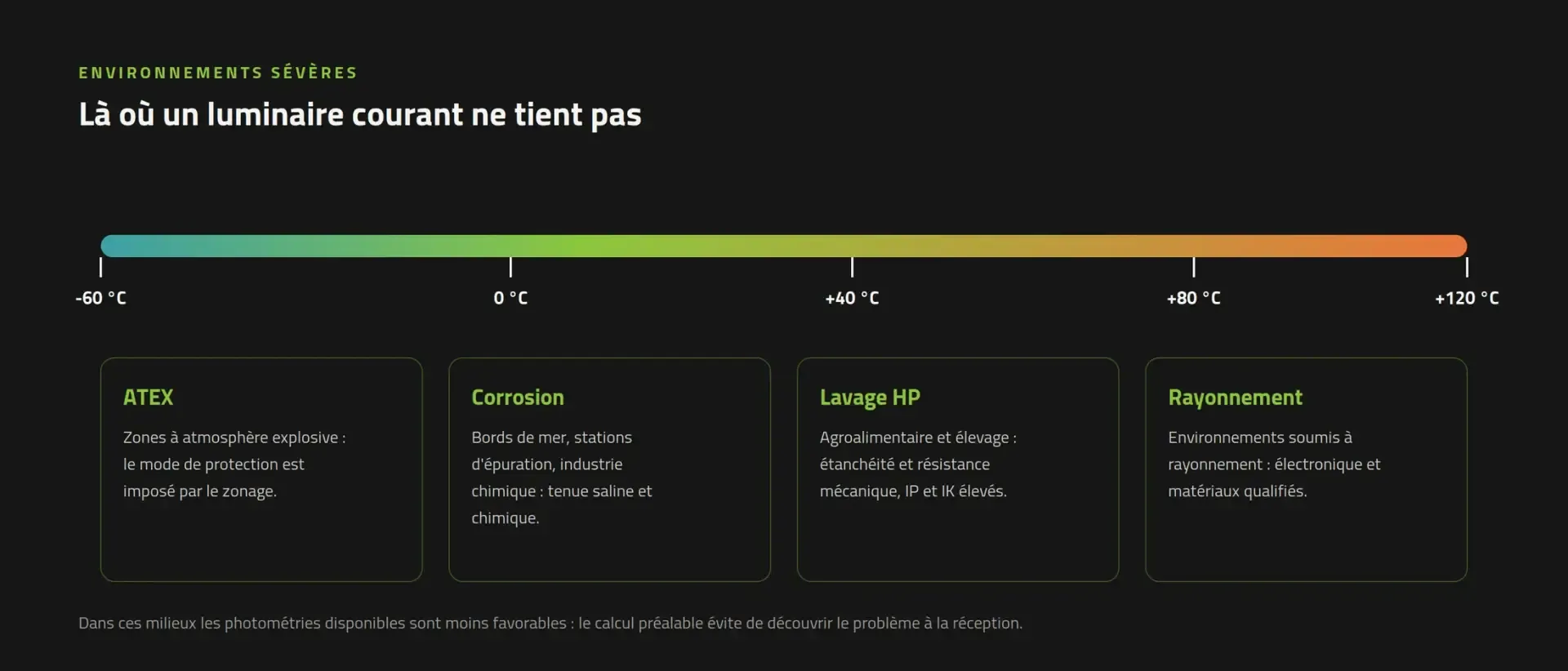
-60 to +120 °C
The range covered by the Extreme Industry line.
Free study
The calculation always comes before the choice of equipment.
What employees say about their lighting
The European Repro-light survey, carried out in 2019 among 1,100 people, measured what lighting changes at work. The figures are sharper than you might think, and they explain why a lighting renovation is judged as much on comfort as on the bill.
87%
of employees believe lighting affects their mood
This is no minor comfort criterion: it is the first factor in the atmosphere of a workplace, ahead of noise and temperature.
90%
say lighting affects their alertness
A drop in alertness at a visual inspection station or at the controls of a vehicle cannot be made up elsewhere.
92%
believe it affects their performance
Poorly sized lighting costs productivity long before it costs kilowatt-hours.
What people ask for, and do not get
40% of respondents say they are dissatisfied with the illuminance at their workstation. Not with the colour of the light, not with the design of the luminaire: with the amount of light where they work. That is exactly what a photometric study measures and corrects.
80% want lighting to adapt automatically. Presence detection, dimming according to daylight, scenes by zone: these functions exist, and are rarely used because nobody sized them. See the control solutions.
The habit to adopt
Before changing a luminaire, ask your teams what bothers them. Dark areas, reflections on screens, glare when seated, difficulty reading a label: this feedback almost always points to the real problem, and it guides the survey.
Twenty criteria before entering the catalogue
A luminaire is not chosen because it is well priced. It is chosen because it meets a grid of twenty technical criteria: flux actually leaving the luminaire rather than the module, measured efficacy, flux maintenance over time, colour rendering, glare control, protection ratings, mechanical strength, behaviour under temperature, quality of the driver, availability of photometric files, warranty and availability of spare parts.
This grid produces four families, depending on what the site requires first.
- 01
Comfort and aesthetics
Offices, meeting rooms, reception areas, retail, healthcare. Priority goes to colour rendering, glare control on screens and the luminance of ceiling fittings. The luminaire is seen: its shape matters as much as its curve. See panels and troffers and acoustic luminaires.
- 02
Reliability and operation
Workshops, logistics, sites running around the clock. Priority goes to flux maintenance over time, the quality of the driver and easy maintenance. A luminaire replaced at height costs more in access than in equipment. See high bays and linear battens.
- 03
Robustness and function
Outdoors, roads, car parks, sports grounds, building sites. Priority goes to sealing, mechanical strength, resistance to frost and vandalism, and limiting light spill. See outdoor lighting, floodlights and site lighting.
- 04
Resistance and safety
ATEX zones, food processing, chemicals, sub-zero cold, high temperatures, environments exposed to radiation. Here the dominant criterion is the survival of the equipment, and the available photometric data is rarer and less favourable. See ranges for harsh environments.
Few brands, known in depth
We are not a general catalogue. We commit to the equipment we recommend, which means knowing a small number of ranges very precisely rather than the whole market superficially.
Rexylum
Our brand of professional LED luminaires, headed by Jean-Claude Martin. Industrial, commercial, sports and outdoor ranges, screened against the LED Charter before entering the catalogue. See the catalogue.
Filamento Lighting
An American partner from Silicon Valley, for sources with very high colour rendering and a controlled spectrum. Useful wherever colour perception governs the work: quality control, sorting, healthcare, retail.
Tridonic
Components, drivers and control systems. It is the electronics that decide the real lifetime of a luminaire, far more than the LED itself.
Extreme Industry range
Equipment designed for settings an ordinary luminaire cannot withstand: from -60 to +120 degrees, explosive atmospheres, corrosive conditions, high-pressure washing, environments exposed to radiation.
Installers
Our own team of installers, or the installer you prefer: large national contractors for multi-site operations, qualified local electricians for nearby projects. Either way, we follow the work through to the check of the levels.
Industry and institutions
Removed luminaires are collected and processed by an approved eco-organisation, in line with articles R543-195 and R543-202 of the French Environmental Code. Members of the French Lighting Association (AFE).
Equipment comes fourth
The order is not negotiable. We measure, we calculate, we express the recommendation as performance targets, and only then do we name a product. If the calculation points to a solution we do not distribute, we say so: an installation that disappoints costs infinitely more than a lost sale.
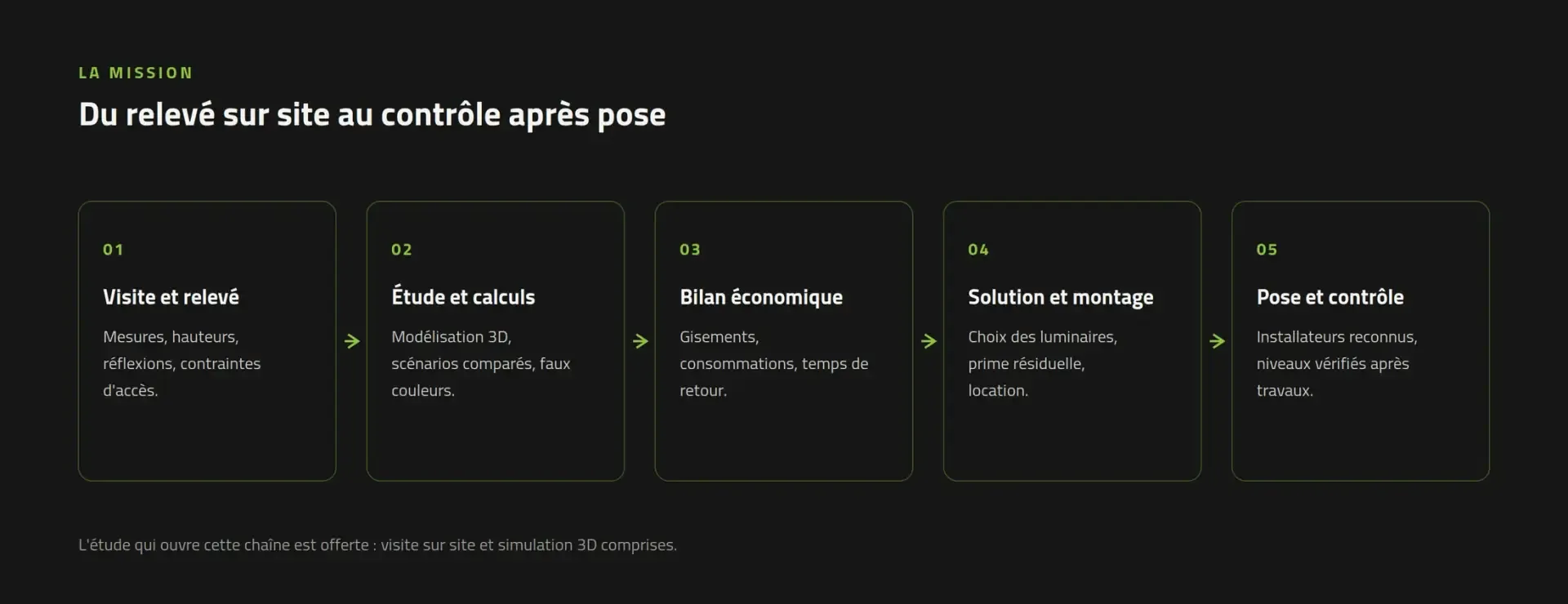
What you receive before choosing anything
- The site survey: heights, grids, obstacles, reflectance values, measurements of the existing installation.
- The 3D model and the false-colour rendering, zone by zone.
- The dimensioned layout plan, ready for the electrical contractor to use.
- The power balance, in watts per square metre and per hundred lux.
- Recommendations expressed as performance targets, not as product references.
- The financing plan: payback zone by zone, long-term leasing, remaining eligibility for energy savings certificates.
The file belongs to you. You can have it priced by whoever you like. The photometric study in detail.
And financing?
The CEE energy savings sheets that funded indoor relamping were withdrawn in February 2026. Financing now comes from long-term leasing, where the monthly saving covers the instalment, and from a payback period calculated on your actual consumption.
A range is chosen after the measurement.
On-site survey, 3D model, costed report and financing plan. The study is free and the file is yours. An engineer replies within 48 working hours.
Luminance Consulting · Lighting solutions consultancy since 2013 · Projects anywhere in France