Indre-et-Loire · Centre-Val de Loire
Lighting design office in Tours and Indre-et-Loire
Luminance Consulting is a professional lighting solutions consultancy, active since 2013, based at Node Park Touraine, twenty minutes south of Tours. We carry out DIALux photometric studies, audits of existing installations and compliance checks for manufacturers, logistics platforms, local authorities and commercial buildings across the department, then support you through to commissioning. The study is free.
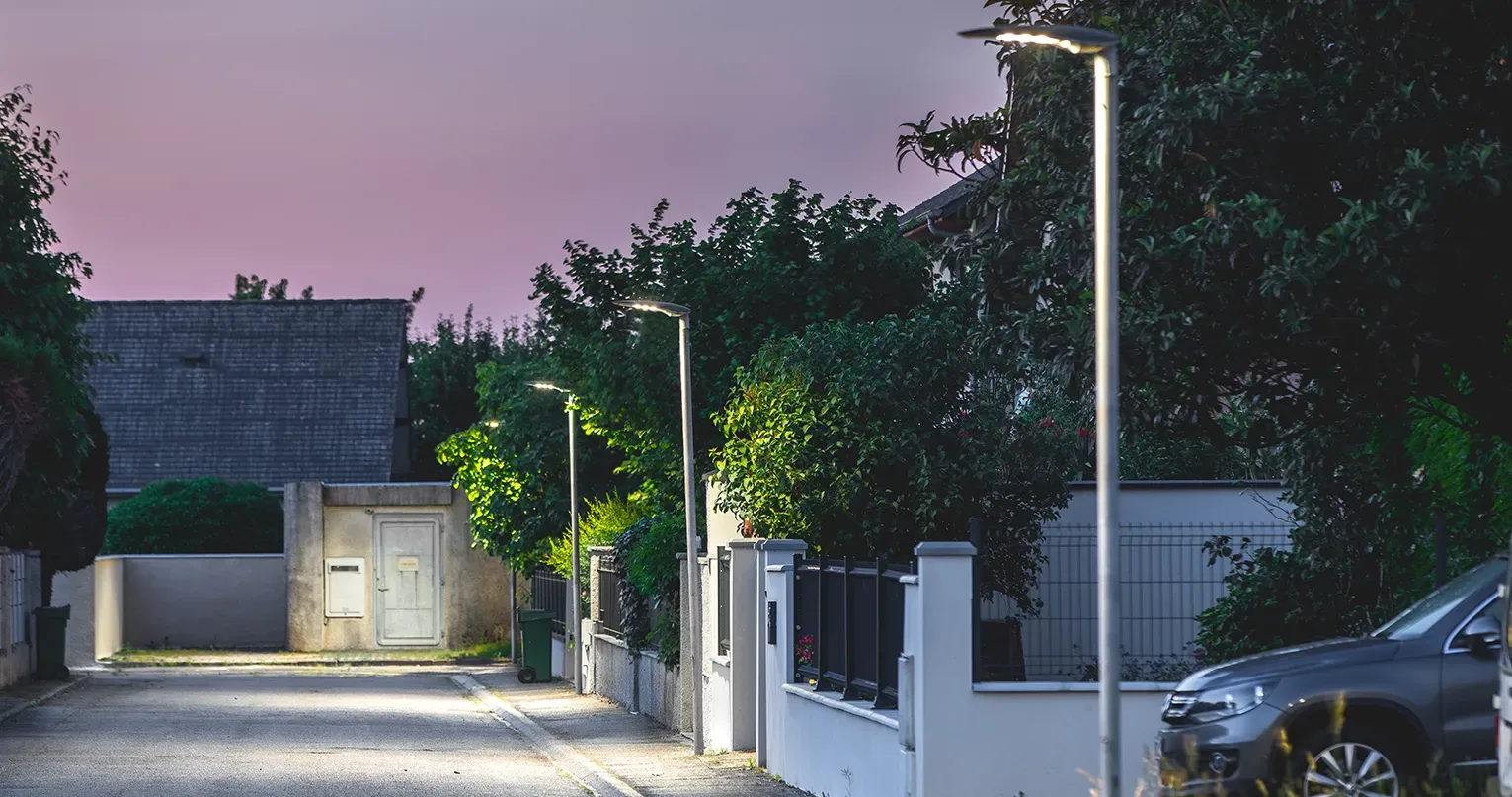
Answered by an engineer, not a switchboard · Site visits across Indre-et-Loire · Free study
Since 2013
Lighting solutions consultancy, and nothing else.
Based in Touraine
Node Park Touraine, 37310 Tauxigny. Projects anywhere in France.
DIALux evo
Photometric calculations and verifiable reports.
Free study
The calculation comes before the catalogue, never the other way round.
In Indre-et-Loire, lighting is still often changed without being measured
In most of the files we take over in the department, the sequence was reversed. The equipment was chosen before anyone measured anything: a point-by-point replacement of the existing installation, luminaire for luminaire, with no survey of heights, no reflectance values, no defined working plane. The installation is fitted, it consumes less than the old one, and yet the feedback comes in: dark areas between racks, glare at seated workstations, visual inspection made harder.
The problem is neither the supplier nor the product. It is the lack of a calculation. Half a day of survey and a model would have pointed to another layout, often with fewer light points. That is exactly what we do before proposing anything, and it is free.
A lighting study commits to levels, uniformity, visual comfort and consumption. It must be possible to reread it, challenge it and check it after commissioning. Only then is a recommendation worth anything.
Six services, one chain
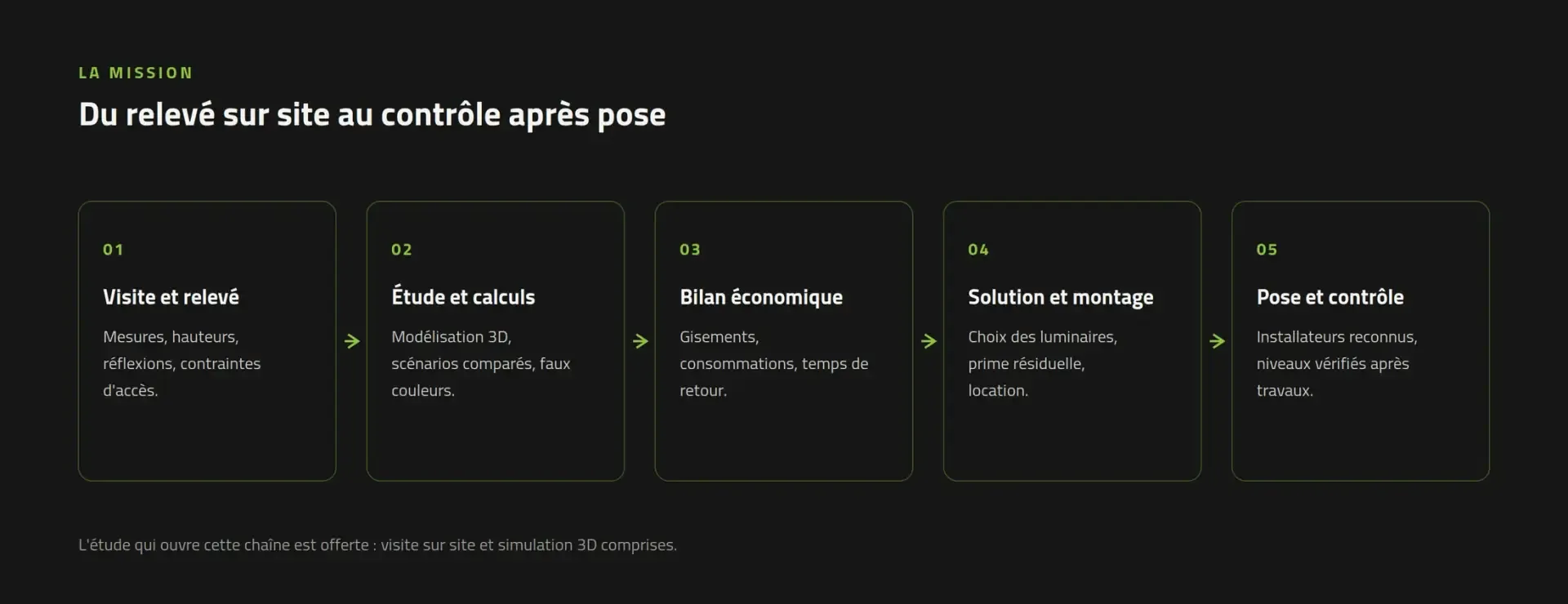
From measurement to commissioning: we audit the existing installation, we calculate, we recommend a solution, we build its financing plan, we have it installed by our team or by the installer of your choice, and we check the levels achieved. The study that opens this chain is free.
DIALux photometric study
Modelling of the real volume, definition of the working planes, calculation of average and minimum illuminance, uniformity, discomfort glare and installed power. The report is delivered with the calculation assumptions, so every value can be traced.
Audit of existing lighting
On-site survey with a lux meter, map of the levels observed, inventory of the sources in place, analysis of operating hours and of the areas actually occupied. The audit separates what must be replaced from what simply needs repositioning or controlling.
Compliance with standards
Checking the installation against the frameworks that apply to your activity: NF EN 12464-1 for indoor workplaces, NF EN 12464-2 for outdoor areas, NF EN 1838 for emergency lighting, the NF EN 13201 series for roads, ATEX requirements in explosion risk zones.
Client-side project assistance
Drafting the lighting specification, comparative analysis of the offers received, review of the photometric files sent by bidders, attendance at acceptance and check of levels after commissioning.
Financing plan
Building the financing alongside the solution: long-term leasing over three to five years with the instalment covered by the saving generated, a check of remaining eligibility for energy savings certificates, and payback calculated zone by zone. As the indoor lighting sheets were withdrawn in February 2026, we tell you straight away what can really be used for your operation.
Second opinion on a study you received
Review of a study produced by a supplier or installer: consistency of the model with the real building, maintenance factor, working planes, treatment of glare, compliance with the applicable framework. A written opinion listing the strong points and the points to correct.
Types of project in Touraine
Indre-et-Loire combines production sites, a logistics corridor shaped by the A10 and A85 motorways, a highly fragmented network of local authorities and an underground wine-growing heritage. Each of these contexts calls for a different photometric approach.
Industry and production workshops
The business parks in the area, from Node Park Touraine to Isoparc in Sorigny, host workshops with similar constraints: high ceilings, overhead cranes, machines that block the luminaires, demanding visual inspection stations. The issue is not the average level, it is uniformity at the workstation and the absence of shadows on the work area.
- Maintenance factor adapted to the workshop's real dust level
- Treatment of discomfort glare at seated or elevated workstations
- Check of colour rendering at sorting, quality control and finishing stations
- Control zoning by production cell rather than by whole building
Warehouses and logistics platforms
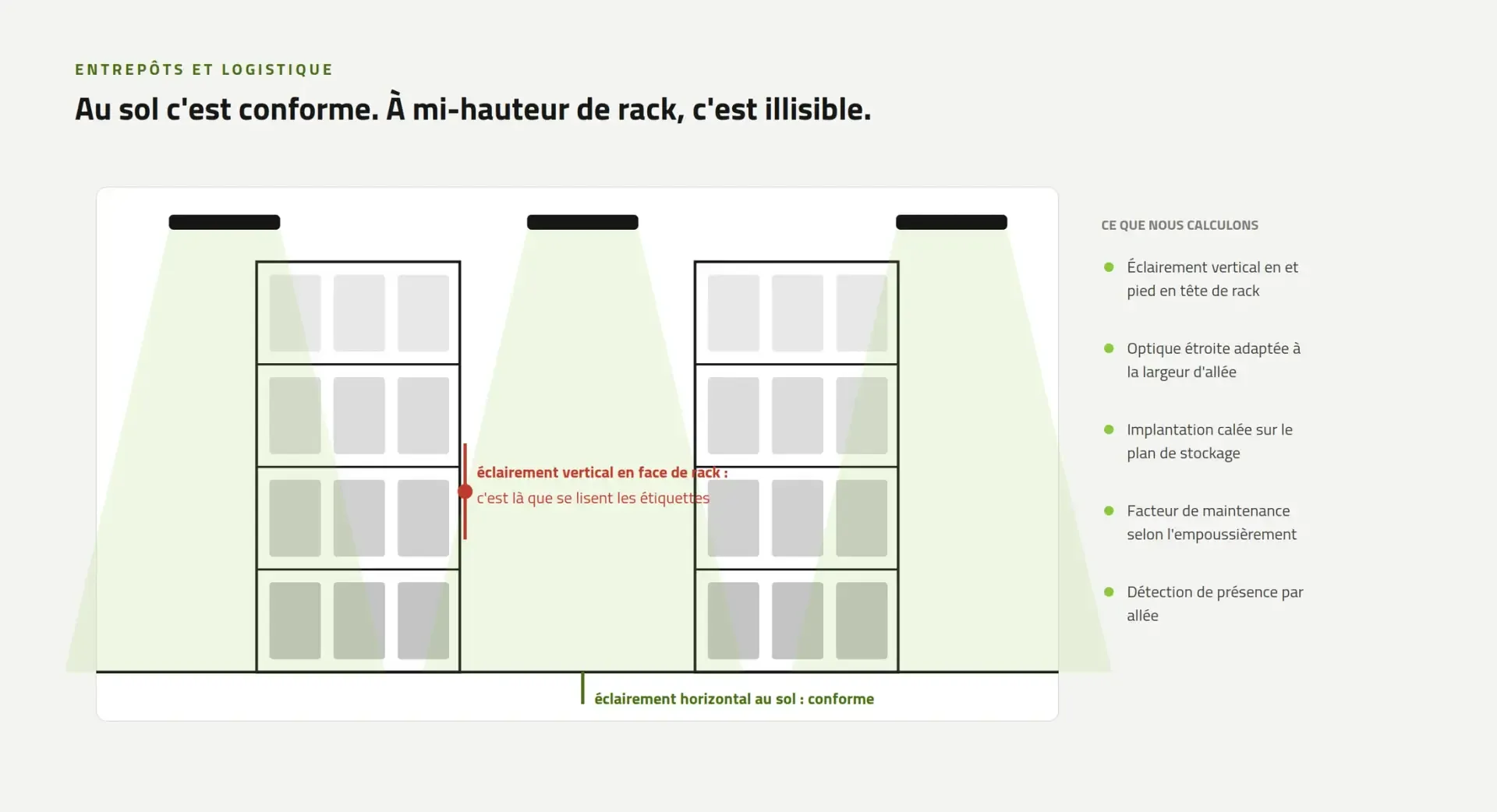
The Tours logistics corridor concentrates high-bay buildings where vertical lighting matters as much as horizontal. A warehouse properly lit at floor level can remain unreadable halfway up the rack, where the labels are read.
- Calculation of vertical illuminance on the rack face, not only at floor level
- Layout of the light lines according to the storage plan, reviewed when the plan changes
- Presence detection by aisle, with timing suited to picking flows
- Check of emergency lighting and exit signage
Local authorities and public facilities
The department's municipalities run mixed public lighting stock, often inherited from decades of successive extensions, and also manage gyms, community halls and outdoor pitches. The subject is as much regulatory as technical.
- Stock diagnosis, road classification and application of the NF EN 13201 series
- Taking into account the provisions on preventing light pollution
- Sports lighting study set to the level of competition sought
- Technical documents usable in a public tender or a joint purchasing group
Offices, commercial buildings and healthcare
On office floors, the regulatory requirement to cut energy use in commercial buildings is driving renovation. Lighting is often the first item tackled, because it is measurable and quick to redo. Provided the occupants' visual comfort does not suffer along the way.
- Illuminance levels set by type of task under NF EN 12464-1
- Control of glare on screens and of ceiling fitting luminance
- Presence detection combined with dimming according to daylight
- Metering and monitoring of consumption to document the reduction trajectory
Wine estates and cellars
From Vouvray to Chinon by way of Montlouis and Bourgueil, part of the department's wine-growing activity takes place underground, in cave cellars where constant humidity, the lack of daylight and heritage constraints rule out standard solutions.
- Protection ratings chosen to match the constant humidity of the galleries
- Task lighting in racking, disgorging and handling areas
- Ambient lighting for tasting and visitor areas, without warming the rock
- Check of routes and emergency lighting in the galleries
Four steps, from the first call to the check after the works
- 1
Scoping
A phone or video call to understand the activity, the areas concerned, the problems reported by the teams and the schedule. At this stage we tell you whether a study is warranted or whether the problem is a simple adjustment. This step commits you to nothing.
- 2
Visit and survey
Site visit in Indre-et-Loire and the neighbouring departments. Measurement of existing levels, survey of heights, grids, wall reflectances, obstructions and fixing constraints. Collection of available plans and operating data.
- 3
Calculation and report
Modelling in DIALux evo, comparison of several layout scenarios, calculation of levels, uniformity, glare and power. Delivery of an annotated report, with the assumptions used and the gaps against the applicable framework.
- 4
Follow-up and check
Analysis of offers if you consult several installers, answers to technical questions during the works, then a check of the levels actually achieved after commissioning. This last step is what turns a simulation into a result.
What a photometric study report contains
A report must be readable by a third party, your insurer or an inspector, several years after delivery. Ours always contains the following elements.
- The calculation assumptions: modelled dimensions, wall reflectance values, maintenance factor used and the reason for that factor
- The working planes considered, their height and extent, zone by zone
- The calculated values: average illuminance, minimum illuminance, uniformity, vertical illuminance where relevant
- The assessment of discomfort glare at representative observer positions
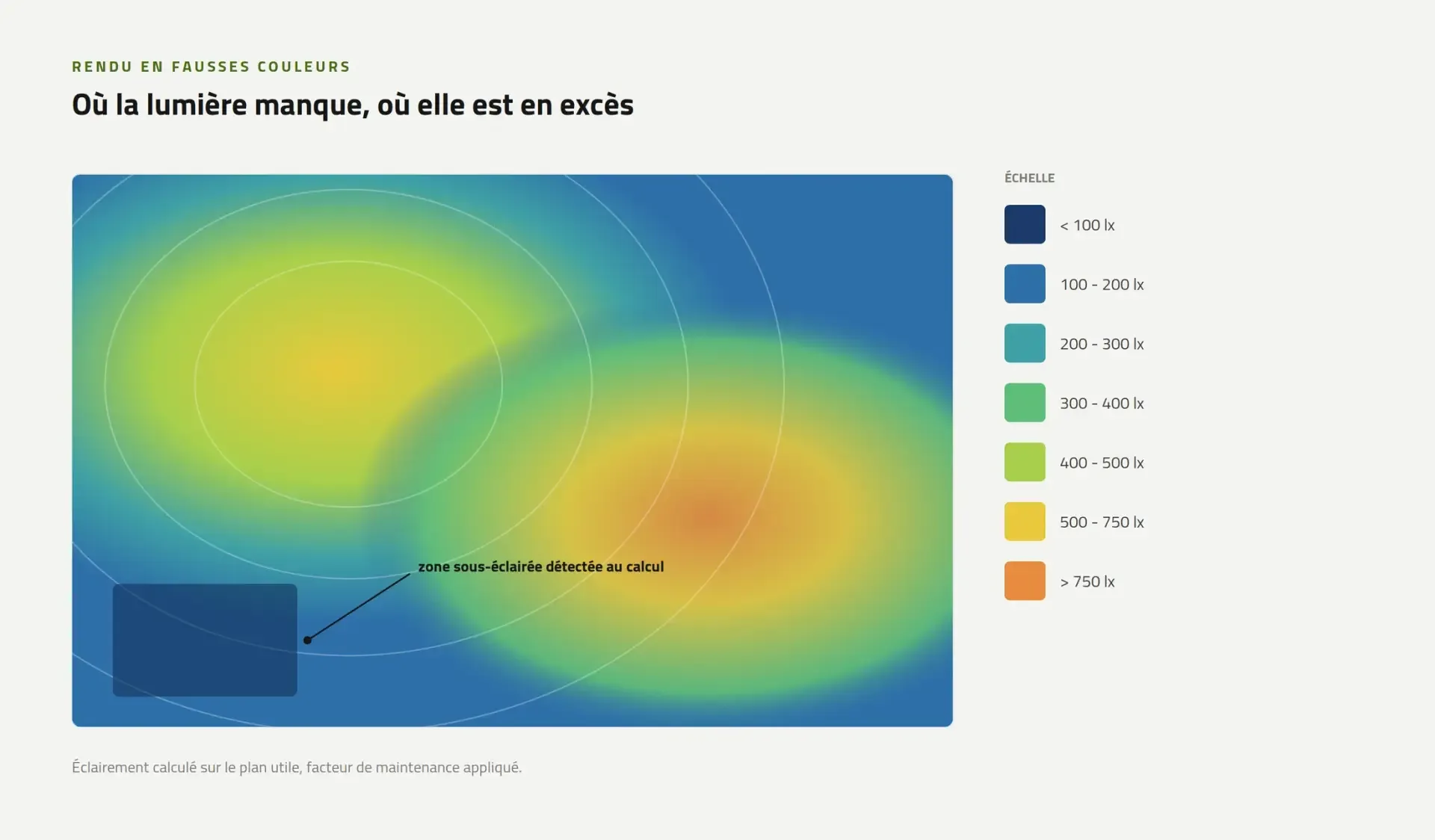
- False colours and isolux curves to visualise the distribution
- The dimensioned layout plan, ready for the company that will install it
- Total installed power and power density, before and after
- The gaps found against the applicable framework, stated plainly
- Reservations and points to check on site before ordering
The photometric files used in the calculations are the manufacturers' own, in IES or LDT format. We use them as published and state which ones were used. No value is adjusted to improve a result.
The frameworks we apply
- NF EN 12464-1: indoor workplaces
- NF EN 12464-2: outdoor workplaces
- NF EN 1838: emergency and escape lighting
- NF EN 13201 series: traffic routes and road classification
- French Labour Code: provisions on workplace lighting
- ATEX requirements for classified sites
- Light pollution: flux orientation and time slots outdoors
These texts change. We work on the version in force at the time of the study and state in the report the edition on which the calculations are based. See the compliance service.
Direct quote, directory or full support
All three options exist and meet different needs. The table below describes what each brings, so you can choose with full knowledge.
| Criterion | Installer quote without a study | Provider found through a directory | Luminance support |
|---|---|---|---|
| Starting point | A point-by-point replacement of the existing installation | Varies with the provider chosen | A site visit and measurements |
| On-site survey | Rarely, often from plans sent | Depends on the assignment ordered | Always, included in the study |
| 3D modelling | Rare | Depends on the assignment ordered | DIALux evo, with false-colour rendering |
| Compliance with the framework | Rarely checked zone by zone | To be specified in the contract | Checked and documented in the report |
| Cost of the study | Built into the quote | Invoiced | Free |
| Financing plan | Not addressed | Out of scope | Long-term leasing and CEE eligibility studied |
| After installation | Manufacturer warranty | Assignment over | Check of levels achieved and follow-up |
Our study is free, and we say why
We are paid on the solution we supply and have installed, not on the engineering. So the study is free, visit included, and the report is yours. The model explained in detail.
Luminaires are chosen after the study
Our calculations rely on the photometric files published by manufacturers, whoever they are, and the recommendation is first expressed as performance targets. Then comes the choice of equipment, which we commit to: we work notably with Rexylum, a French brand of professional LED luminaires whose ranges we know in detail, with Filamento Lighting and with ranges designed for extreme environments. The calculated result decides, not the catalogue.
From Touraine, across Centre-Val de Loire
Our depot is at Node Park Touraine, in Tauxigny, where the routes serving Tours, the Indre valley and the south of the department meet. This location lets us reach your site within the day across most of the region. The depot does not receive visitors: we come to you.
Indre-et-Loire
Tours and Tours Métropole Val de Loire, Joué-lès-Tours, Saint-Cyr-sur-Loire, Chambray-lès-Tours, Amboise, Loches, Chinon, Sorigny, Monts, Cormery, Bléré, Château-Renault, Langeais, Azay-le-Rideau.
Neighbouring departments and the region
Blois and Loir-et-Cher, Orléans and Loiret, Vendôme, Romorantin-Lanthenay, Bourges, Châteauroux, Chartres. We work across the whole of Centre-Val de Loire and consider requests further afield when the project warrants it.
Meet us
Luminance Consulting
Postal address and depot
Node Park Touraine
90 rue Guglielmo Marconi
37310 Tauxigny, France
The depot does not receive visitors. For a first exchange, a call is usually enough to qualify the need and schedule a visit to your site.
Frequently asked questions
Do you work on sites outside Indre-et-Loire?
Do you charge for the photometric study, and how long does it take?
We have already received a study from our installer. Can you review it?
Is a study needed for a simple like-for-like replacement of luminaires?
Lead time, price, scope, travel: the four questions most often asked by businesses in the department.
Describe your site, we come to measure it
A building, a problem reported by your teams, a regulatory deadline or a renovation project: tell us the situation in a few lines. We get back to you with a first technical reading and a visit date. The study is free.
You would rather call
A ten-minute call is usually enough to qualify a need. You will be speaking with the person who will carry out the study.
Luminance Consulting · Lighting solutions consultancy since 2013
Node Park Touraine, 90 rue Guglielmo Marconi, 37310 Tauxigny